Shroud Map

(Shroud Map Based on Photo Negative Image)

The image becomes positive in a photographic negative indicating that the image on the cloth is a negative image.

Front Map
Back Map
Interactive Map


Front Map (ventral image)

Based on the image as seen in a photo-negative.
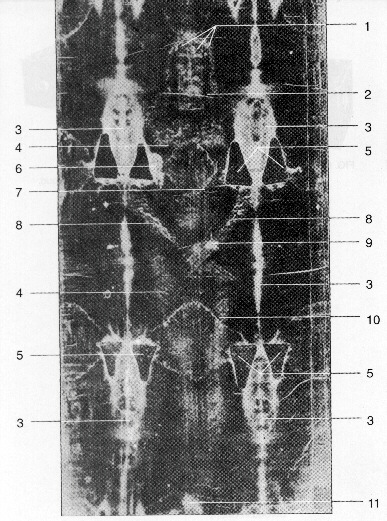
    1. Crown of thorn wounds

    2. Crease in linen

    3. Burns from 1532 fire

    4. Scourge marks

    5. Repair from fire

    6. Side wound from Spear

    7. Water stains

    8. Blood flow on arms

    9. Nail wounds

    10. Water stains

    11. Nail wounds in feet


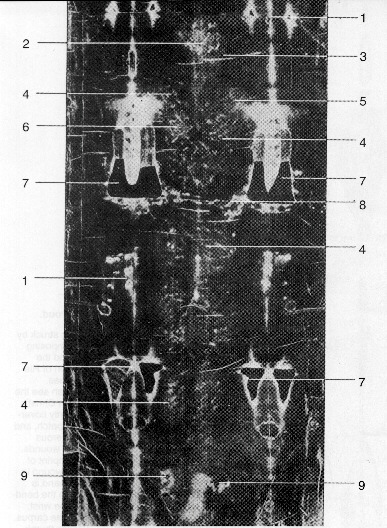
Back Map (dorsal image)

    1. Burns
    2. Crown of thorn wounds

    3. Crease in linen

    4. Scourge marks

    5. Shoulder wound

    6. Left shoulder-blade wound

    7. Repair from fire

    8. Blood flow from side wound

    9. Nail wound


Interactive Map

Actual cloth is 14 feet long with the image of the man measuring approximately 5'10". Move your curser across the image for an explanation of most of the markings. Interactive tag only viewable using Microsoft Explorer.

One of 8 burns and patches from 1532 fire. Bloody foot.  Blood stains match up with those on the other end showing how the body was wrapped lengthwise Hands showing nail in wrist.  No thumbs due to severing of nerve. Wound in the side with blood flowing down.  Chemistry shows clear separation of blood and serum. Face showing full beard and long hair typical of the Nazarenes. Back of head shows profuse bleeding from apparent crown of thorns. Back shows multiple lacerations from apparent scourging, over 120 such marks on the body. Blood across small of back shows post mortem blood flow after body was laid down horizontal. Back of legs showing one leg elevated as in crucifixion.  Scourge marks cover both legs. Feet show clearly one foot placed upon the other as in crucifixion.  Nail wound with blood trailing off is clear. One of 8 burns from fire in 1532 and patches from the repair in 1534. Burns and patches from 1532 fire Water stain that shows the image is not water soluble.  Edges are calcium deposits. One of numerous water stains in a pattern that shows how the cloth was folded and stored in an urn similar to the Dead Sea Scrolls.  Pattern is another clue to the Shroud's antiquity. Section removed in the early 1500's as a royal gift. Side strip that runs entire length of cloth.  Part of original material but uncertain as to when seam was added. May have been part of original Shroud since similar stitching has been found excavations at Masada. General corner that was cut for carbon dating.  Same exact corner that was held and grabbed hundreds of times over the centuries which resulted in medieval repair ultimately giving a false date for the cloth's origin. L-shaped pattern of burns from an apparent accident with a incense censor during a liturgical ceremony.  Burn incident pre-dates 1532 fire and is evidence the cloth was in Constantinople prior to its arrival in France as demonstrated by the Hungarian Pray Manuscript. Same L-shaped pattern as above due to the way cloth was folded. One of numerous water stains that form a pattern on the cloth due to the manner in which the cloth was folded. Water stain on abdomen, outline of the stain is calcium. One of 8 burns and patches from 1532 fire. One of 8 burns and patches from 1532 fire. Scorches from 1532 fire flouresce under UV spectroscopy. The image has similar spectrographic characteristics but does not flouresce.  The image looks like a scorch but isn't. Scorch marks between burn holes from 1532 fire. Blood on arms.  Blood chemistry tests positive for hemogloboin, serum albumin, bile, bilirubin, and other blood components. Burn mark from 1532 fire.


Shroud University • © 2008 • Shroud of Turin Education Project, Inc.
P.O. Box 3397, Peachtree City, GA 30269 • Office 678-817-7188
Contact UsSite Map Home